The Sidhe Courts
No one knows why Underhill exists. It simply does: outside of time, saturated with wild magic, and populated by a staggering variety of Fae creatures of which the Sidhe are only one. They are, however, the species most adept at bending Underhill to their will, and the evidence of that is everywhere.
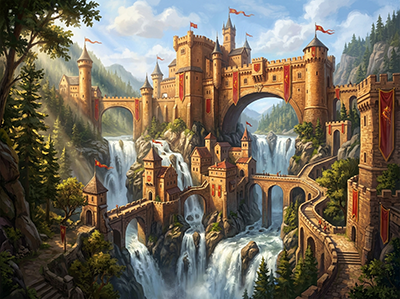
Each Court and Clan carves its territory out of the surrounding chaos through sheer magical force, and the result reflects the power and personality of whoever shaped it. A Clan's territory might be a maze of medieval stone buildings set into the face of a waterfall, or a network of treehouses strung between a grove of birch trees grown to impossible heights, or a sun-drenched town spilling over with Mediterranean color and flowers. In Underhill, what you can imagine and what you can make real are the same question, and the answer depends entirely on how powerful you are.
There is something familiar in all of it, by design. The Sidhe draw on mortal imagination to fuel their creation: the dreams, stories, and creative lives of the mortal world seep through in ways that the Sidhe have always found useful, even if they would not always admit the debt.
Between these ordered territories, however, Underhill is something else entirely. Untamed, unpredictable, and indifferent to the survival of anyone passing through it, the wild spaces between Clan holdings are not navigated so much as survived. Movement through Underhill beyond the Sidhe territories is handled through connective portals that bypass the distance and the things that creep and stalk the chaos.
All courts are subjects of the Queen and King of the Fae. Each court’s leadership is broken down into a hierarchy similar to ancient Irish family based clan structures. Hierarchy is fluid within and largely determined by power levels, although Winter Court makes some notable exceptions, valuing elder experience above magical prowess.
At the top of the hierarchy with the most intense powers are Titania and Oberon, who rule over all of the courts. Within each Court, the most powerful individual is the Rí Ruirech (pronounced (roll the Rs) Ree Roo-reck), or overking, ruling over all clans within the Court. Beneath that role are the clan chieftans, or Rí Túaithe (pronounced (roll the Rs) Ree Too-ray-hay), and fluid specialty classes.
Specialty classes include the martial and spiritual leaders of the Courts, who may pledge fealty to a Clan but aren’t required. Wizards, Druids, and Warriors are specialty classes.
Clans are families that include the primary clan lineage, mates married into the clan, bannermen who have taken oaths of fealty to the clan and their families, and mortal fosterlings.
Clan leadership are expected to observe certain major holidays at the Overking’s Clan, and attend other Court functions when requested. The Rí Túaithe and their mates are mandatory, heirs nearing or at adulthood are expected, other Clan members may attend as they wish, and fosterlings are welcomed (subject to their leaders’ invitation). Missing attendance at functions without first receiving dispensation from the Overking is considered disrespectful, and can be considered a challenge.
Holiday Court functions may also involve neighboring seasonal Sidhe Courts. Winter and Summer Court do not attend one another’s functions, and generally only see one another twice a year in Titania and Oberon’s hall during Solstice.
While not directly at war, Summer and Winter (and by association Spring and Autumn) have always indirectly been at war. Power ebbs and flows seasonally, and every Sidhe is affected.
Oberon & Titania
Oberon and Titania are not rulers, so much as they are the closest thing the Sidhe world has to forces of nature wearing a face. Where each seasonal Court holds a piece of what the Fae can be, Oberon and Titania are everything: the warmth of Summer and the severity of Winter, the wild renewal of Spring and the gorgeous melancholy of Autumn, all at once, all the time, without contradiction. Their power does not shift with the seasons. It does not wax or wane with the solstice or bend to the politics of any Court. They simply are, in the way that very old and very deep things simply are, and every Sidhe alive knows the difference between their own considerable power and the skirling storm Oberon and Titania bear between them.
Oberon is raven-haired and tall, with the kind of stillness that belongs to very old forests — the sense that he was here before you arrived and will be here long after you leave. His eyes shift between the deep green of a summer canopy and the flat silver of a winter sky depending on his mood, and his mood is as easily read as one might read a redwood’s. He dresses like someone who has never needed to impress anyone: rich but unshowy, dark tones, the occasional flash of something ancient worn for its enjoyment rather than its value. He is charming in the way that an ancient river is charming: beautiful, easy on the surface, and not something you want to underestimate the current of. He and Titania circle each other in a competition running longer than any of the Courts have existed: for dominance, for amusement, for the particular pleasure that two people of equal power take in finding the one being in the world they cannot simply outmatch. He takes favourites among the powerful and brilliant of the Courts from time to time. These attachments burn bright and cool with the kind of graceful inevitability that suggests he always knew how they would end.
Titania is luminous in the way that is difficult to look away from and slightly dangerous to look at directly for too long. Her hair is the color of late autumn light, somewhere between gold and copper and the particular red of a leaf at its most spectacular moment before it falls. She moves through any room as though the room reoriented itself around her arrival without being asked. Her eyes are green, but the green of new things growing through frost rather than the easy green of summer, and they miss very little. She is warmer than Oberon; more openly playful, more immediately present. This has led more than one powerful Sidhe to mistake approachability for softness, an error that is not made twice. Her interest in the Courts is genuine and wide-ranging, and she has favourites of her own among the Sidhe, drawn to power and originality in equal measure, bestowing her attention like sunlight and withdrawing it with the same lack of personal malice. Her competition with Oberon is the longest-running and most entertaining political drama in the Sidhe world, and she is aware that everyone is watching it, and she does not mind at all.
Seasonal Magic
Every Sidhe is born with a magical affinity tied to their Court, as natural and indelible as the color of their eyes. It does not need to be taught so much as recognized. A young Spring Sidhe does not learn to feel the pull of growing things, they simply one day notice that they always have. What is taught is precision, control, and the deeper understanding of what their magic actually is and what it costs.
Seasonal magic is not only a toolkit. It is an expression of the elf's fundamental nature, which means it is also tied to their emotional and physical state in ways that can be inconvenient. A Winter elf in genuine grief has been known to frost the ground in a radius around them. A Summer elf's anger runs hot in the most literal sense. Spring's magic surges in the presence of new life and becomes volatile under sufficient loss. Autumn's magic responds to change: the more in flux a situation, the more potent an Autumn Sidhe, which makes them either very useful or very dangerous in a crisis depending on the individual.
Power within a Court is not equal. It varies by Clan, by bloodline, by age, and by the individual, but all Sidhe power waxes and wanes with the literal seasons. A Winter Sidhe in December in their own territory is not the same creature as a Winter Sidhe in July in Summer Court. They are still formidable. They are simply not at the height of what they can be. This seasonal flux is a source of enormous political relevance, and the timing of any significant inter-Court event is never accidental.
Oberon and Titania stand entirely outside this system, which is part of what makes them what they are. For everyone else, magic is a season. For them, it is simply power — constant, sourceless, and inexplicable.
When a Sidhe's Seasonal Magic Changes
Formal Diplomatic Transfer
The most sanctioned form of movement between Courts. A member might be sent as a permanent ambassador or liaison, essentially gifting their allegiance to another Court as a political gesture. This would be rare and significant, not a casual reassignment but a deliberate act with ceremony around it on both sides. The Sidhe in question would likely carry a dual identity for a long time, considered "of Summer" by Winter and "of Winter" by Summer simultaneously, belonging fully to neither.
Marriage or Bonding
A cross-Court union that results in one partner joining the other's Court. Given the weight all Courts (especially Spring and Autumn) place on consent and invitation, this would have to be entirely willing, but it would still be culturally enormous. The transferring Sidhe would likely face a long period of being regarded as an outsider by their new Court, especially in Winter, where trust is built over lifetimes. The transferring Sidhe will also notice their magic changing gradually to reflect their new Court's season. There have been a few extremely rare exceptions over the generations, typically in times of significant upheaval.
Exile
Involuntary, but common enough to be worth including. A Sidhe cast out of their Court for breaking sacred laws — violating a sworn oath in Spring, betraying a Clan in Winter, some unforgivable act — might seek asylum in another Court. Whether they are accepted would depend on the circumstances and the relationship between the Courts at the time. An exiled Spring Sidhe might find Autumn's door most open to them, given that relationship. An exiled Winter Sidhe seeking Summer's protection would be a much thornier situation.
Falling Out of Season
Sometimes Sidhe lose their connection to their birth season, through profound grief, trauma, magical injury, or a profound change in self. They may find themselves drawn to another Court not by political choice but because something in them has shifted, and their magic begins reflecting a different season. This is regarded as deeply strange and alarming by all Courts, but Autumn, with its understanding of transformation, might be the most equipped to receive someone going through it.
Mortal Fosterlings
Clans in all Courts raise mortal children. Most members of the Sidhe value children, due to extreme difficulties with conception and birth among their own kind. Orphans, foundlings, and mistreated youth in the mortal world may find themselves in the company of an otherwordly beautiful person with sky-blue or grass-green eyes and blonde hair, offering them shelter and freedom in a world of endless possibility. All Courts are similar in that Sidhe generally see humans and other mortal species as highly intelligent beasts, similar to how humans perceive dolphins. They don’t all agree that human culture is real. There are philosophical arguments that what Sidhe would call ‘culture’ is actually the result of anthropomorphizing mortals. However, they do all agree that humans have some degree of sentience in a ‘wouldn’t it be interesting if we could fully understand them?’ sort of way.
Most Sidhe families identify and train whatever talent their mortal fosterlings possess. Art, music, dance, equitation, martial arts, philosophy, poetry, artifice, engineering; if an interest exists, the Sidhe pride themselves on finding it and growing it into a passion. All mortal fosterlings must be able to leave Underhill at the age of 16 (considered adulthood) if they so choose, regardless of court affiliation. Some of the greatest thinkers, creators, and leaders of the mortal realm are Sidhe Court Fosterlings. For the human children that the Sidhe spirit away, a childhood Underhill is an avenue to a Great Destiny.
That said, every Court has its share of intrigues and darker intentions. It needs to be stressed: a fosterling’s death is only a tragedy to the Sidhe who valued its life, much as a beloved horse is mourned by the owner who doted on it. The Sidhe view the shortness of mortal life similar to how we view the shortness of our pets’ lives. Personal grudges might be held over the significant injury or accidental (and sometimes no so accidental) death of a fosterling, but permanent rifts in the court do not happen over the abuses of human children. You may think that people who declaw cats are gross, but at the end of the day you believe that the cat belongs to another person who has the right to do what they want within the law, even if it upsets you and you view it as an abuse. It’s an abuse the law allows. You certainly wouldn’t give that person a cat or recommend anyone else do so, but you’re not going to call the police on them or take them to court. You hope they took the cat to a vet who declawed them as painlessly as possible, and you hope they take their cat’s declawed existence into consideration when they arrange their home, but you sort of assume the kind of person who would declaw a cat doesn’t really care that much about the health or agency of the animal. You consider yourself pretty powerless to stop it at the cultural level.
Eventually, you forget about the individual declawed cat.
Welcome to Court.
The Solstice Masquerades
There are two Solstice Masquerades: the Summer Solstice Masquerades, hosted in Summer Court territory, and the Winter Solstice Masquerades, hosted in Winter Court territory. The hosting Court has a significant, if unspoken, advantage. They are on their own ground, at the height of their power, and everyone present knows it. Oberon and Titania's presence is what makes attendance mandatory and keeps the peace formally intact, but the hosting Court sets the tone, the aesthetic, and the seating, and they are not subtle about using all three.
Attendance is not optional. Every Court sends its significant Clan leaders, and the act of appearing is itself a political statement. You acknowledge the authority of Oberon and Titania, the legitimacy of the seasonal compact, and the terms of every treaty currently in operation. Absence without an accepted reason would be interpreted as a declaration of defiance or disrespect.
The Summer Solstice Masquerade
Hosted in Summer territory at the height of its power, the Summer Solstice Masquerade is the most visually spectacular of the two gatherings and the one most likely to exhaust everyone who attends it. Summer throws the kind of hospitality that is also, unmistakably, a flex. The sheer radiant abundance of everything on display is a statement about Summer's power dressed up as generosity, and every other Court reads it exactly that way while eating the food anyway because it is extraordinary.
Winter attends the Summer Solstice Masquerade the way a stone attends a flood: present and immovable. Their delegation tends to be smaller than strictly necessary, dressed in their full winter palette against the gold and warmth of Summer's territory, and almost aggressively unbothered. Summer finds this irritating. Winter is aware of that and considers it a minor victory.
Spring and Autumn move through the Summer Solstice Masquerade with considerably more ease. Spring enjoys the celebration genuinely while quietly noting everything, and Autumn is in its element — a gathering of every significant political player in the seasonal world, all slightly off-balance on someone else's territory, is essentially Autumn's ideal social environment.
The Winter Solstice Masquerade
The Winter Solstice Masquerade is a completely different animal. Winter hosting means Winter's rules of hospitality apply — which means the welcome, once extended, is genuine and absolute, but the price of entry is submitting to Winter's particular brand of formal assessment. Arriving at a Winter Solstice Masquerade feels different from arriving at Summer's. The halls are dark stone and firelight, the warmth is earned rather than ambient, and the silence between conversations is longer and more deliberate. Winter is not performing abundance. It is demonstrating endurance.
This is the gathering where the most significant political business actually gets done, because Winter's environment strips away Summer's theatrics and forces a kind of directness that the other Courts find clarifying even when they find it uncomfortable. Autumn thrives here too, for the long dark, the thinning of the veil near the solstice, and Winter's stripped-back formality all suit Autumn's temperament.
Summer's delegation at the Winter Solstice Masquerade is the mirror image of Winter's at Summer's, and they radiate controlled discomfort that they would never admit to. A Summer Court Sidhe in Winter's territory at the depths of winter is genuinely diminished, and managing that gracefully while maintaining the appearance of full power is one of the more demanding performances their Court requires of its diplomats.
Oberon and Titania During the Solstice Masquerades
The High King and Queen are the axis around which all of this turns, and their own relationship to the Courts is worth considering. They stand outside the seasonal allegiances by definition, but they did not come from nowhere. There would be speculation, long-running and never fully resolved, about which Court they originally belonged to or favor, and both Oberon and Titania would be skilled at feeding and denying that speculation in equal measure depending on what was politically useful.
Their power at the Solstice Masquerades is the power of the chair at the center of a room where everyone else is trying not to look like they're watching each other. They set the formal agenda, mediate disputes that have escalated beyond Court-level resolution, and ratify or dissolve treaties. But their real function is simply to be the reason everyone stays in the room together. They are the one authority that all four Courts have, for their own separate reasons, decided it is not worth challenging. What those reasons are, and whether they are the same for all four Courts, is the kind of question that Autumn elves turn over quietly on long evenings and never quite answer.
The Undercurrent
Beneath all the formal ceremony, the Solstice Masquerades are where every slow-burning inter-Court tension gets its twice-yearly airing. Old grudges surface in the seating arrangements. Alliance shifts get telegraphed through who speaks to whom during the between-session hours. Fosterlings who have returned to the mortal world and become significant figures sometimes appear as mortal guests, which creates its own complicated atmosphere. Clans from Summer and Winter who are technically at armistice find themselves in the same hall and manage it with varying degrees of grace.
Autumn watches all of it, remembers all of it, and says very little unless asked. Spring is warm and sociable and forgets nothing. Summer performs magnificently and reads the room less carefully than it should. Winter says exactly what it means and lets everyone else decide how to feel about that.
And twice a year, the seasonal world holds together for another turn of the cycle.
Quick Links
Spring Court
Overking Clan: Dawnrush
Notable Clans:
Briargrove
Rainspark
Thornbloom
Wildmantle
Misthollow
Culture & Values
The Spring Court genuinely believes they are the benevolent force of the seasonal courts. They are protectors of life, growth, and new beginnings. This self-image is not wrong, but incomplete. They revere life above all things which makes them generous, warm, and welcoming to outsiders, but capable of terrifying wrath when life is threatened or their laws are violated. Their deepest cultural belief is that everything deserves a chance to grow, which sounds lovely until you realize they apply that same patience to grudges. The Spring Court never forgets. They simply wait.
Their code of laws around consent, invitation, and promises is not just cultural preference. It is cosmically binding. Breaking an oath made in Spring's name is considered one of the worst things a Seeleighe Sidhe can do, and the Court takes enforcement of this personally. This also means they are careful about what they promise. Spring Court Sidhe play no games around these three areas. They never invite someone somewhere they don't mean to welcome, and they never keep someone past the point of their agreed release. Fostered mortals in the Spring Court who request their freedom at sixteen, return to their own world exactly the number of years they’ve been away. Spring Court fosterlings are the most likely to meet their kin again, of all the Courts.
Aesthetic & Homeland
Visually, most Clan Holds (territories) within the Spring Court reflects Ireland in April: stunning and treacherous in equal measure. Their homeland is lush, intensely green, and alive with wildflowers, rivers, and ancient forests, but the sky is enormous and unpredictable. A warm golden morning can become a sideways rainstorm by afternoon with no warning. Most Clans lean into this: open-air halls with enchanted roofs, buildings grown from living wood and flowering vines, stone that has been shaped rather than cut.
Their fashion mirrors this duality. On fair days they wear light linens and soft colors; creams, pale greens, lavender, the yellow of a primrose. When they go to war or pass judgment, they wear deep ivy greens, storm grey, and the bruised purple of a sky before lightning. Thorns are a recurring element in their designs. Thorned blooms may be beautiful up close, but painful if grabbed without care.
Magic & Abilities
Spring Court magic centers on growth and change. They can accelerate life. Spring Court Wizards can heal wounds, coax crops, or cause something to grow so fast it becomes monstrous. The same magic that mends a broken bone can make roots crack stone and forests swallow cities. Their connection to storm is equally important: rain-calling, wind, and lightning are all within reach of a skilled Spring Court Wizard, reflecting spring's tendency to turn savage without warning.
Because they live so long, potentially forever, Sidhe magic also has a deep relationship with time as it relates to living things. Most Sidhe can read the age of something by touch, sense death approaching in a person or plant, but the Spring Court may slow or delay the dying of a living creature. They cannot cheat death entirely, but they can bargain with it in small ways.
Their vulnerability is worth noting here: despite their immortality, they are not invincible. Like all Sidhe, Spring Court elves suffer in the presence of Cold Iron, but they also struggle in drought. Spring Sidhe deprived of rain and green growing things for long enough begin to wither. Most Spring Court Sidhe do not thrive in highly populated areas as a result unless green spaces have been prioritized. Generally, when they live outside Underhill, Spring Court Sidhe prefer agrarian centers.
Social Customs & Traditions
Hospitality is paramount, but it is formal hospitality. An invitation from a Spring Court Sidhe is not casual. It is a promise, and should always be viewed as such. If you are invited in, you will be fed, sheltered, and protected. If you enter without invitation, you have broken something sacred and they are no longer bound to treat you well. This gives their social customs a very particular texture: extraordinarily warm inside the bounds of welcome, and quietly, dangerously cold outside of them.
Spring Court Sidhe celebrate birth in all forms—the first day a foal stands, the first flower through frost, the birth of a child—with joyful, communal festivals that can last days. However, they also mark death with equal ceremony, because they understand its weight in a way that mortals perhaps don't: for a being who may live forever, losing someone is not something you get used to.
Promises are made with a specific verbal formula. Forget handshakes; a Sidhe promise is a spoken exchange where both parties repeat what they are agreeing to. Vague promises are considered rude at best, dangerous at worst, as magic has a way of interpreting them literally.
Relationships with Other Courts
The Spring Court has the most complicated relationship with the Winter Court; not quite enemies, not quite allies. Spring ends Winter's reign, and Winter ends the seasons of growth, resulting in both resentment and a deep (if grudging) respect. The history between them is long, and far from clean.
With the Summer Court, Spring is warm but quietly competitive. Summer is brighter, more obvious in its power. Spring sometimes feels that Summer takes credit for what Spring began. Spring is an older sibling who did all the hard early work, watching the younger sibling reap the benefits.
The Autumn Court is perhaps their most comfortable relationship. Autumn begins where Spring's work ends, harvesting what Spring grew, and the two share a philosophical understanding about cycles even if their temperaments differ.
Spring's self-appointed role as "the good guys" can make them condescending toward the other Courts, even unintentionally. They have a habit of framing their own interference in others' affairs as help, which the other Courts find anywhere from mildly annoying to genuinely infuriating.
Fostering Mortals
Spring is, on the surface, the most visibly warm and welcoming Court for a Fosterling. Spring values life and new growth above all things, and a mortal child represents both. Fosterlings in the Spring Court would be included in festivals, taught the names of every plant and creature in their territory, and made to feel beloved.
The complexity comes with Spring's sacred laws. A Spring Court Fosterling would be educated very seriously about consent, invitation, and the keeping of promises from an early age. Spring would consider it a profound act of care to make sure the child understood the rules of the world they were living in. A Fosterling who accidentally violated one of these laws would (usually) be treated with patience and correction rather than punishment, but the correction would be firm. Spring loves its Fosterlings the way it loves everything: generously, but with very clear expectations.
There would also be a particular bittersweetness to the Spring Court's relationship with their Fosterlings that the elves themselves might not fully acknowledge. A Court that may live forever, raising a child they know will grow old and die, would feel that weight. Some Spring Sidhe would pour an almost overwhelming amount of care into their Fosterlings for exactly this reason.
Summer Court
Overking Clan: Cedarbow
Notable Clans:
Emberfall
Brightwater
Lightwood
Stormglow
Verdantgrove
Culture & Values

The Summer Court believes, with complete sincerity, that they are the natural leaders of the seasonal world. Long days, abundant warmth, and the full flourishing of everything Spring began sits squarely in their domain; it’s true that they are powerful. But their greatest flaw is that they have never entertained the possibility that they might be wrong about something. Members of the Summer Court are generous, radiant, and capable of great kindness. However, their generosity tends to come with the quiet expectation of gratitude. Summer gives freely, but it notices when thanks are not offered.
Summer Court Clans value excellence, beauty, and bold action. Hesitation is not a Summer Court virtue. Where Spring is patient, Summer acts; sometimes brilliantly, sometimes catastrophically. They have a deep appreciation for artistry and celebration, and their festivals are the most elaborate of all the Courts. Underneath this brightness is the knowledge that the longest day is also the beginning of the slow decline toward Winter, which the Summer Court does not like to consider.
Aesthetic & Homeland
Ireland in July and August is not the scorching summer of southern Europe. It is endless golden evenings, sudden warm spells that feel like a gift, and savage thunderstorms that roll off the Atlantic. Summer Court Clan territories reflects this, particularly the overking’s: vast open landscapes, ancient hills, coastlines where the sea glitters with seductive danger, and skies that cycle through a dozen shades of gold before the sun finally, reluctantly sets around ten at night.
Their aesthetic is rich and solar, with deep golds, warm ambers, burnt orange, and the particular bright blue of an Irish summer sky on a clear day. Their clothing is elaborate and tends toward the dramatic: layered, flowing, embroidered with patterns that suggest light on water or rippling heat haze. They favor jewelry made of gold and warm-toned stones like beryl, tourmaline, selenite, sunstone, and carnelian. When they dress for conflict, the softness drains out of their palette. What remains is the stark white-gold of the sun at its most punishing noon height: beautiful and without mercy.
Magic & Abilities
Summer Court magic is the most immediately impressive of the four Courts, which they know. They command light, heat, and the full abundance of the growing season. A Summer Sidhe at the height of their power can scorch crops, blind enemies with concentrated light, call down the fury of a summer thunderstorm, or pour vitality into an ally like sunlight through a window. Their healing magic is less subtle than Spring's. Where Spring coaxes growth, Summer burns away infection and weakness.
Their magic is tied to visibility and truth in an interesting way. Sunlight hides nothing, and neither do Summer Court Sidhe when they are at full power. As the dawn burns away evening fog, Magic users in Summer Court can see through invisibility and glamours, reveal traps and lies, and identify spells and curses. Their presence tends to be felt before they are seen. However, this also means they are at a notable disadvantage in true darkness. While Summer Sidhe are susceptible to Iron as all of the Fae, a Summer Court Sidhe stripped of all light is diminished and weak. This goes some way toward explaining their feelings about Winter, who thrive in darkness.
Social Customs & Traditions
Summer Court society is theatrical and communal. Their great halls are open to the sky whenever possible, their celebrations spill outdoors, and status within the Court is often demonstrated through lavish hospitality. The grandest feast, the most elaborate festival, the most generous gift. There is real joy in this, and it would be a mistake to dismiss it as mere performance. Summer Sidhe love a party. There is always an audience, and the Summer Court is always, on some level, aware of being watched.
They mark the Summer Solstice as their highest holy day—the longest day—with a festival that runs from the previous sunset to the following one, filled with music, performance, and dance, and entirely without sleep. It is considered a point of pride to greet the next dawn still standing. They have complex coming-of-age traditions tied to the first time a young Sidhe calls significant magic, which is treated as a public event and celebrated in kind.
Unlike Spring, they are less formal about promises and invitation, which occasionally gets them into trouble. They tend to make declarations in the heat of the moment and mean them at the time. Whether they follow through is a matter of individual character more than Court-wide law.
Relationships with Other Courts
Summer and Spring have the warmest relationship of any Court pairing — a genuine alliance built on complementary power and mutual respect, though with that undercurrent of competitiveness that Spring quietly nurses. Summer tends to be fond of Spring in the way a brilliant, popular person is fond of a reserved friend who they know is smarter than they let on. They just don't always act on that knowledge.
Summer's relationship with Autumn is cordial and respectful but carries a wariness. Autumn's alliance with Winter sits uneasily with Summer, and Summer is never entirely sure which way Autumn is facing in any given moment. They appreciate Autumn's counsel when they can get it honestly, but they are not always sure they are getting it honestly.
Winter and Summer do not get along. This is the foundational tension of the seasonal world, and both Courts feel it in their bones. The armistice holds because it must, but there is no warmth in it. Power shifts between them in a cycle neither can break. Summer finds Winter cruel and joyless. Winter finds Summer arrogant and blinding. Both are at least a little correct.
Fostering Mortals
Summer court Sidhe are unique in their broad selection of mortal children to foster, but also their willingness to give fosterlings full disclosure in their the freedom of choice. Summer court Fosterlings always have the choice to leave. While there are a few lords and ladies of the Summer court who enjoy creating puzzles and mysteries for their mortal guests to solve, most prefer to give incentives to stay rather than keep them on as ‘involuntary guests.’ Mortal orphans may go from freezing in an alley to a fairytale castle on a mountain or a fantasy enclave of treehouses in the deep woods, with all of their needs more than met. Summer Fosterlings are truly treated like Sidhe children; dressed in finery and raised alongside any elven youngsters who might be at Court.
A Summer Court Fosterling would have a genuinely exciting (if exhausting) childhood. Summer loves brilliance and boldness, and they would encourage both in their Fosterlings with great enthusiasm, celebrating every achievement publicly, pushing the child toward bigger and better performances of their talents, and making them feel, at their best moments, like the most important person in any room.
The difficulty is that Summer's attention, like sunlight, moves. A Fosterling who struggled, who was quiet or uncertain or took longer to find their confidence, might find the Court's warmth directed elsewhere until they found a way to shine. Summer would not be cruel about this — they would not even necessarily notice they were doing it — but a mortal child navigating a Court that prizes radiance above most things would learn quickly that visibility is currency.
At their best, Summer Court Fosterlings would emerge at sixteen bold, accomplished, and with an unshakeable sense of their own worth. At their most complicated, they would emerge with a deep need for an audience that took years to untangle.
Autumn Court
Overking Clan: Sun-Descending
Notable Clans:
Ashenveil
Thistledown
Cinderhollow
Harvestwane
Ravenswatch
Ravensong
Culture & Values
The Autumn Court is the most self-aware of all four Courts, as they have the most clear-eyed understanding of what they are and how their presence affects the world. They know they are a transitional Court, the hinge between the open warmth of Summer and the insular severity of Winter. Autumn Court has made peace with that role in a way that has given them a philosophical depth the other Courts sometimes lack; they carry that self-awareness like a lantern in a long corridor. They know that the same wind that shakes the last ripe apples from the tree also strips the leaves and leaves the branches bare. They simply try to make sure the apples were worth it.
Their trickster nature is real, but usually benevolent. They test, provoke, and nudge rather than deceive for personal gain. An Autumn Court Sidhe who leads you down a confusing path is more likely trying to show you something you needed to see than to leave you lost. It won’t be surprising to know how fond Autumn Court is of the mortal realm’s tools for divining the future; they love divination cards like tarot most of all, and a fortuneteller with a reputation for truth may have some connection to Autumn Court. That said, they are not without self-interest, and their position between Winter and Summer means they have become extraordinarily skilled at navigating relationships with competing loyalties. They are the Court most likely to know everyone's secrets, and use them to their own ends.
Like Spring, they hold consent and invitation as important values, though their interpretation is perhaps slightly more flexible. Autumn understands that sometimes you have to shake the tree to make anything fall, and they are comfortable with a degree of productive disruption that Spring dislikes.
Aesthetic & Homeland
Ireland in October is dramatic, gorgeous, and a little haunted. The light goes golden and then amber, before the days begin to shorten with a speed and sharpness that feels personal. The rain returns in earnest, the wind picks up, and the landscape cycles through extraordinary color before letting it all go. Mists settle into valleys in the mornings. The line between the beautiful and the eerie becomes very thin.
The Autumn Court's homeland reflects all of this: ancient forests in full color, rivers running fast and dark, stone ruins half-swallowed by moss and ivy, and a sky that performs spectacular sunsets before pulling a dark curtain down earlier each evening. There is a sense of richness in the landscape, alongside a creeping awareness that it is all about to go.
Their aesthetic runs through the full fire spectrum of autumn foliage: deep reds, burnt orange, rich gold, warm brown, and the particular purple-grey of a twilight sky in late October. They tend toward layered, practical clothing that wouldn't look out of place in the forest — but there is artistry in the layering, and their ornamentation tends toward natural objects: seed pods, feathers, small bones, amber. They are the Court most likely to look like they belong to the landscape rather than standing apart from it.
Magic & Abilities
Autumn Court magic centers on transformation and release. They are skilled at compelling change, accelerating decay (which sounds grim but is only the return of one thing into the material for something new), preserving what should be kept, defusing curses and charms, and reading the threads of cause and consequence with an accuracy that borders on (but isn’t) prophecy. They understands cycles the most deeply of any Court, which makes them excellent (and unsettling) advisors, because they will tell you honestly what they see coming.
Their trickster magic manifests as illusion and misdirection, the kind of subtle perceptual shift that makes you look twice at something you'd walked past a hundred times, or makes you forget you saw it at all. Minor illusions are frequently a part of storytelling, and Autumn Court Bards and storytellers excel at creating vibrant worlds of imagery and sound around their audiences. They are also closely associated with the veil between the living and the dead. In Irish tradition, autumn is when that veil thins, and Autumn Court elves feel that thinning as a tangible thing. They can communicate with the dead more easily than any other Court, and some can briefly manifest, anchor, or dispell trapped spirits. This is considered sacred work, not necromancy. Autumn Court Sidhe are no more capable of or tended towards raising the dead with any permanence than any other Court. In fact, Autumn’s influence over spirits and understanding of the cycles of life and death make the thwarting of that cycle anathema. Disrespect for the natural processes of death and decay is one of the quickest ways to make Autumn Court your enemy.
Their vulnerability is tied to stagnation. An Autumn Sidhe trapped in unchanging circumstances, unable to move or transform anything around them, begins to struggle in a way that goes beyond frustration into genuine magical diminishment.
Social Customs & Traditions
Harvest and remembrance sit at the heart of Autumn Court culture. Their most important festivals are celebrations of abundance and acts of memorial. The feast is always partly for the dead as well as the living, and a place is set for those who are no longer present. This is not morbid in their culture; it is deeply comforting. In the opinion of the Autumn Court, the dead are not gone, only changed - and transition deserves recognition and celebration. Like Summer, Autumn Court loves a party. Outdoor celebrations that fall between Summer’s heat and Autumn’s frost are some of the best, lush with memories captured in the fragrant, deliciously spooky, ever-changing space between the bonfire and the shadows.
Storytelling is a central art form to Autumn Court. Not everyone has a Bardic gift for telling stories that capture the heart and steal the breath, but in Autumn Court, everyone has a story anyway. They are the Court with the longest and most carefully maintained oral and written histories, because their deepest belief is that to be forgotten is the only true death. Bards, historians, and lorekeepers hold high status in Autumn Court society. The telling of someone's story at their death is considered one of the most important rituals a Clan can perform.
Their trickster traditions manifest in their coming-of-age customs. Young Autumn Sidhe are sent through a period of deliberate disruption and misdirection, a kind of guided chaos designed to teach adaptability and self-knowledge. It is considered affectionate rather than cruel, though outsiders sometimes find it baffling.
Relationships with Other Courts
Autumn and Spring have the easiest relationship of any Court pairing. They are philosophically aligned in ways that go deep. Both understand cycles, both hold consent and care as values, and both have a clear-eyed view of their own capacity for harm that the other two Courts lack. Spring's long memory and Autumn's archival nature mean they share a great deal of history carefully maintained on both sides. They argue occasionally, but they argue like people who trust each other.
Autumn's relationship with Summer is warm but carries a particular diplomatic complexity. Summer knows that Autumn is also allied with Winter, and watches that alliance with one eye always. Autumn navigates this with more grace than Summer gives them credit for, but it is genuinely a careful balance to maintain. Autumn is fond of Summer's brilliance and exhausted by Summer's ego.
Autumn and Winter's alliance is one of the most interesting relationships in the seasonal world. They are far from similar, but there is a mutual respect built on Winter's appreciation for Autumn's honesty and Autumn's genuine understanding of what Winter carries. Autumn does not romanticize or condemn Winter's severity the way outsiders do. Winter appreciates being seen clearly.
Fostering Mortals
Autumn would arguably be the most thoughtful Court when it comes to Fosterlings (don’t tell Spring Court), and also, depending on the Clan, the most quietly dangerous one to be placed with. While this seems contradictory, Autumn is the Court that understands transformation most deeply, that sees cycles and change with a clarity the other Courts rarely match. A mortal child is, to certain Autumn Court eyes, the most interesting transformation of all. The care is genuine. An Autumn Court Fosterling is steeped in stories, taught the histories of every Clan, shown how to read the subtle shifts of a situation the way you read weather, and raised to understand that things are always in the process of becoming something else. Fosterlings who leave Autumn Court will always be excellent storytellers, in whatever avenue they choose: historians, philosophers, researchers, writers, songwriters, dancers, actors, and musicians; drawn to the stories of the mortal world with a thirsty curiosity that can never be quenched.
Autumn's trickster nature shows up consistently in their upbringing: lessons delivered sideways rather than directly, small tests of adaptability woven into daily life, the occasional carefully orchestrated disruption designed to teach the child something about themselves that could not have been taught any other way. At their best, these Fosterlings would emerge with a philosophical flexibility and depth of self-knowledge that children raised in any other Court rarely possess.
The complication is time. Some Autumn Court Clans stretch it.
It is well within the power of certain Clan territories to slow the passage of time for a Fosterling: to hold them at eleven, or thirteen, or fifteen, for what feels from the inside like a long golden season but is, from the outside, decades. A mortal child placed with one of these Clans will not become sixteen on any schedule that corresponds to the mortal world. They will become sixteen when the Clan decides, or when the magic shifts, or when something in the Court's long and patient attention moves on. Autumn understands cycles, after all. It simply does not always feel obligated to explain which cycle is currently in operation.
This means that almost no Autumn Court Fosterling returns to the mortal world the same number of years after they left. Some return to find a year has passed when they remember a decade. Others step back through to find everyone they knew is dead and buried. The Autumn Court is not unaware of this outcome. They simply regard it as part of the transformation. The Fosterling who returns is not returning to who they were, so why should the world they return to be unchanged? Autumn would frame this, if pressed, as a kindness. The Fosterling is spared the slow grief of watching their family age around them. They are released into a clean break, a new beginning, like a seed dropped into unfamiliar soil.
That the Fosterling did not choose this is a detail Autumn tends to set aside, even as it holds consent as a value in most other areas of its culture. This is the thorn: the Court that sees everything most clearly has a particular talent for deciding unilaterally what is best for those in its care. The cage is real, even when the life inside it was mostly wonderful. And for a Court that prides itself on honesty, the fact that this is almost never discussed openly with Fosterlings until it is far too late says something that Autumn, to its credit, knows about itself. It simply has not yet decided to change.
Winter Court
Overking Clan: Shatterstar
Notable Clans:
Rimesong
Hallowdale
Frostreach
Hailspire
Culture & Values
The Winter Court's core belief shapes everything about them: survival is not cruelty, and the cold does not apologize. But it is not the whole picture, and anyone who meets only the Winter Court's outer face and thinks they understand the Court is making a potentially fatal mistake. Beneath the severity is something that the other Courts, Summer especially, rarely acknowledge: Winter is the season of endurance and shelter. The hearth exists because of the cold. The warmth of a shared fire in a long dark night is a Winter Court gift, and those who have earned their protection know it in their bones.
The Court is deeply divided in temperament between Clans who embody the sacred, sheltering warmth of winter—rest, homecoming, the blue hour of a December evening when the lights come on in every window—and Clans who are as wild and merciless as a blizzard off the Atlantic. Both are genuinely Winter. The Court does not see these as contradictions. Cold kills, and cold also preserves. Dark is dangerous, and dark is also rest. Winter contains multitudes.
They are suspicious and slow to trust, and their circle of protection is not easily entered. But for those within it, Winter Court loyalty is absolute in a way that Summer's warmth and Spring's welcome are not. Those Courts invite broadly. Winter chooses narrowly and keeps forever.
Aesthetic & Homeland
Irish winter is not the deep-freeze of continental Europe. It is something stranger, and in some ways harsher. It is the relentless grey Atlantic wind, the rain that comes horizontally, the dark that arrives at four in the afternoon and doesn't leave until eight the next morning. But it is also the particular crystalline beauty of a hard frost on a still morning, the drama of a winter coastline with waves battering against black rock, the extraordinary stars visible on a clear winter night when the air is sharp and clean. It is a landscape stripped to its essentials, and there is a severe beauty in that.
The Winter Court's homeland reflects this: vast dark coastlines, frozen moorlands, ancient pine forests that hold snow in their branches, and mountains that disappear into cloud. Their settlements are built for endurance: deep into hillsides, sheltered in valleys, constructed from dark stone and old wood, with fires that never go out. Stepping inside a Winter Court hall from the cold outside is a specific, powerful experience that they understand and use.
Their aesthetic is the full winter palette: deep navy and midnight blue, silver, white, black, the dark green of pine, and the occasional startling red of berries against snow. The warring Clans of the wilder tradition favor stark, dramatic clothing designed for movement in brutal conditions. The Clans of the sheltering tradition favor heavier, layered garments in deeper colors, fur-lined and ornate in a way that suggests warmth earned and kept. Their ornamentation tends toward silver, bone, and dark stone.
Magic & Abilities
Winter Court magic is built around preservation, endurance, and inevitable force. Their elemental command of cold, ice, and darkness is the most obvious expression of this — they can freeze, shatter, and obscure with formidable power. A Winter Sidhe at full strength in their homeland in the deep of December is not something to face lightly. But their magic has a subtler dimension that outsiders overlook: they are extraordinarily skilled at slowing and preserving, keeping things in stasis, holding something at the exact moment before it changes. This has obvious combat applications, but it is also how they have maintained ancient oaths, magical artifacts, and some rare living things across spans of time that would astonish the other Courts.
Their connection to darkness gives them abilities around perception in low light that no other Court can match, and some of the elder Winter elves have a relationship with the long dark that borders on communion. They can move through it in ways that suggest the darkness knows them. While Winter Sidhe cannot stand the touch of Cold Iron as all Fae, their vulnerability is tied to thaw. A forced and sudden warmth is deeply uncomfortable, and prolonged exposure to Summer's specific kind of light is genuinely weakening. They are also, though they rarely admit this, vulnerable to isolation. A Winter Sidhe cut off from their Clan for too long begins to lose themselves, becomes vulnerable to the kinds of wild things that live in the chaos of Underhill, and may disappear altogether.
Social Customs & Traditions
Winter Court society is built around the Clan more than any other Court. Where Summer performs for an audience and Autumn maintains the thread of memory across all communities, Winter collapses inward. The Clan is everything: the warmth against the cold, the reason to endure. Outsiders are assessed slowly and at length before being granted anything approaching trust, but the process of being brought fully into a Winter Court Clan's circle of protection is one of the most meaningful things their culture offers, and those who have experienced it tend to describe it in terms usually reserved for profound religious experience.
Their most important traditions center on the Winter Solstice—the longest night—which is simultaneously their holiest and most solemn observance. Clan leadership are called to attend the High Court Solstice Masquerade, but those not chosen to be acknowledged by Oberon and Titania gather close to hold the season in their own way. Unlike Summer's celebration of light, Winter's Solstice is a vigil: the acknowledgment that the darkness is at its fullest, and the community has endured together to reach this point. The fires kept burning through the longest night are not decorative. They are a statement of intention. Like the fire in the core of the home, the passion that burns at the center of Winter Court can be seen tonight, when the Sidhe join voices together in song. Harmonies twine like frost on a window as voices of every range become one, stretching and growing until their music fills and echoes in the dark. Examples: Mo Ghile Mear and The Parting Glass performed by The Choral Scholars of University College Dublin
They are the Court with the strictest hierarchy within individual Clans, though the hierarchy is built on demonstrated endurance and loyalty rather than birth or brilliance. An elder of a Winter Clan has simply survived more, endured longer, and kept more people safe, and that is considered the only résumé that matters.
Relationships with Other Courts
Winter and Autumn have a quiet, genuine alliance built on mutual respect rather than warmth. Autumn sees Winter clearly without romanticizing it or fearing it. In turn, Winter finds that rare enough to value deeply. Autumn is one of the few Courts that Winter will listen to, and in the long game of inter-Court politics, Autumn's counsel has more than once quietly shaped Winter's decisions in ways Summer would find alarming if it knew.
Winter's relationship with Spring is one of careful, ancient tension with a complicated history. Spring ends Winter's reign every year, and Winter feels that. There is resentment in it, but also a grudging recognition. Spring is the proof that even the longest dark ends, and Winter, which endures more than any other Court, understands endurance. The formal treaties between them hold. The feelings beneath the treaties are more complicated.
Winter and Summer are the fundamental opposition. The armistice is real and both Courts know that breaking it would be catastrophic. The power flux between them is the engine that keeps the world running, and outright war would damage something neither could repair. But the armistice is cold and formal, maintained through necessity rather than any goodwill. Individual Clans from both Courts have their own ongoing conflicts and rivalries that play out at the edges of the formal peace, and both Courts tacitly allow this as a pressure valve. The day a Winter Clan and a Summer Clan stop feuding entirely, the Court leaders will probably be more worried, not less.
Fostering Mortals
A Winter Court Fosterling would have the steepest initial climb of any child across the four Courts, and the most variable experience, because Winter is not a unified Court in the way that Spring or Autumn is. Which Clan accepts a Fosterling matters enormously, and not every Fosterling is lucky.
Clans Rimesong and Hallowdale take the responsibility seriously, the experience would be what Winter at its best offers: a steep but genuine climb toward belonging. A mortal child arriving in these households would be regarded with the same careful, measured assessment that the Court applies to everyone who is not yet proven. They would be safe, spoken to honestly, given real responsibilities appropriate to their age and ability, and allowed to demonstrate their character over time. When a Fosterling earned their place in Rimesong or Hallowdale - and they would know when they had, Winter is not subtle - the shift would be complete and unconditional. To be folded into a Winter Clan's inner circle is one of the most significant things that Court offers, and a Fosterling who reached that point would carry it with them for the rest of their mortal life.
Then, there are the other Clans.
Clans Hailspire, Frostreach, and Shatterstar view mortals not as children deserving of protection and formation, but as curiosities and amusements. Fosterlings placed with these families would be safe in the narrowest technical sense — Winter's laws around protection are not so easily discarded, even by those who resent them — but safety and care are not the same thing.
Shatterstar Fosterlings find themselves in a Court that sees their mortality as weakness, their emotions disproportionate, and their presence somewhere between a novelty and an inconvenience. They would not necessarily be mistreated in ways that could be formally named. They would simply be made to feel, in a hundred small and elegant ways, that they matter as a concept, not as an individual. Shatterstar Fosterlings return to the mortal world with quiet fury in their hearts, and a frost that never fully thaws. They spend the rest of their lives striving to feel adequate, driven to risk, and sometimes to ruin in that pursuit.
Hailspire and Frostreach Fosterlings were selected, not found, to feed the Clan’s ambitions for power. Within each Clan, mortal children with sorcerous gifts are hammered mercilessly with lessons and drills designed to hone and grow their power. As a result, Hailspire has a reputation for creating mortal wizards with incredible - and destructive - abilities surpassing those trained in mortal magical schools. Rumors abound that Frostreach has even begun to… tinker… with their Fosterlings, seeking any means necessary to compete with Hailspire. Frostreach is ambitious, and a Fosterling who shares that ambition may prosper, but only so much as their keepers allow. All too often, Fosterlings fall short of their Clan’s outsized expectations. Burnt out, broken in mind, body, or both, these children find themselves abandoned in the mortal realm.